
Last Updated: November 6, 2026
Quick Summary
The right 4WD mechanic has formal trade qualifications, current registration and insurance, and regular experience with your make and model. Ask technical questions about transfer cases, differentials and suspension geometry, and insist on a written quote that separates parts from labour before any work starts.
- Confirm trade qualifications, current registration and insurance before booking any workshop.
- Ask how they check the transfer case and set suspension geometry after a lift.
- Request a written quote listing parts, labour and assumptions before any work begins.
- Confirm the warranty on parts and labour in writing, including aftermarket components.
- Ask whether you will be called before extra work is approved on your vehicle.
Table of Contents
- Why a 4WD Needs a Mechanic Who Knows the Difference
- Mechanic Qualifications and Experience That Actually Matter
- Questions to Ask a Mechanic Before You Book
- How 4WD Logbook Servicing Works and What It Should Include
- Warning Signs, Diagnostics and Written Quotes
- Modifications, Warranty Implications and Your 4WD Repair Checklist
- Booking Your 4WD Service With Northside Autocare
- Frequently Asked Questions
Why a 4WD Needs a Mechanic Who Knows the Difference
Choosing the right 4WD mechanic is not the same as choosing one for a sedan. Four-wheel drive systems, heavier suspension, and off-road use create faults that a general workshop may not see often. The first step is recognising that difference before you book anything.
A general mechanic can change oil and rotate tyres well. But a 4WD carries transfer cases, differentials, and sometimes modified suspension that need specific knowledge. Ask yourself how often your vehicle leaves the bitumen. The answer shapes what kind of expertise you need.
Many owners find that a mechanic who understands their driving style catches problems earlier. Early detection usually means cheaper, simpler repairs. That is the real goal of this guide.
Mechanic Qualifications and Experience That Actually Matter
Qualifications are a starting point, not the finish line. Look for a trade-qualified technician with formal automotive training, and confirm the workshop holds current registration and insurance. Ongoing technical training matters just as much, because a 4WD mechanic’s systems knowledge must keep pace with each new model and drivetrain configuration.
Experience with your specific make and model is valuable. A workshop that services your vehicle regularly will know its common weak points, the torque specifications for its driveline, and the service intervals the manufacturer sets. Ask how long the team has worked on vehicles like yours and what diagnostic tools they use.
- Formal trade qualifications in automotive mechanics
- Ongoing training on newer 4WD and drivetrain systems
- Regular experience with your vehicle make and model
- Familiarity with diagnostic tools for modern vehicles
- Current workshop registration and insurance
How to Verify 4WD-Specific Expertise
Do not rely on a sign out front. Routine automotive experience and genuine four-wheel-drive expertise are different things, and the gap shows up in the questions a technician can answer without hesitation. A general mechanic may be excellent at engine and brake work but rarely touch a transfer case, a locking differential, or a lifted suspension setup.
Ask direct, technical questions and listen for specifics rather than reassurance. A capable 4WD specialist should be able to explain, in plain language, how they would check each of the following:
- Transfer case operation, including whether it engages cleanly in high and low range
- Differential fluid condition and the correct specification for your vehicle
- Driveshaft, universal joint, and CV joint wear
- Suspension geometry after a lift, including caster, camber, and toe
- How the vehicle’s traction control and stability systems interact with off-road modes
Vague answers like “we can handle it” tell you little. Detailed answers about driveline checks, diff fluid service, and suspension geometry tell you much more. Ask for examples of similar jobs they have completed, and read customer reviews and recommendations carefully to confirm the claims.
Watch out: a workshop that cannot explain how it tests a transfer case or differential before quoting is likely guessing, and guessing on a 4WD driveline is expensive.
Matching the Mechanic to Your Vehicle and How You Use It
Your driving habits should guide your choice. A family vehicle that mainly sees city streets has different needs from a 4WD towing a caravan on remote tracks, and the workshop’s experience should match the harder use.
If you tow, ask whether the workshop routinely inspects transmission and differential temperatures, brake condition under load, and the towbar and wiring. If you tour remotely, ask about pre-trip inspections and their experience with long-range fuel systems, dual batteries, and recovery points.
If you have modified your vehicle, look for a workshop with experience in custom suspension and accessory fitment. Confirm that the mechanic understands how modifications affect your warranty, including whether aftermarket parts are covered and how a lift or larger tyres change load ratings and insurance obligations.
Questions to Ask a Mechanic Before You Book
Before you hand over your keys, ask a few direct questions. Good answers reveal how the business operates, and the pattern of answers across two or three workshops is more useful than any single reply.
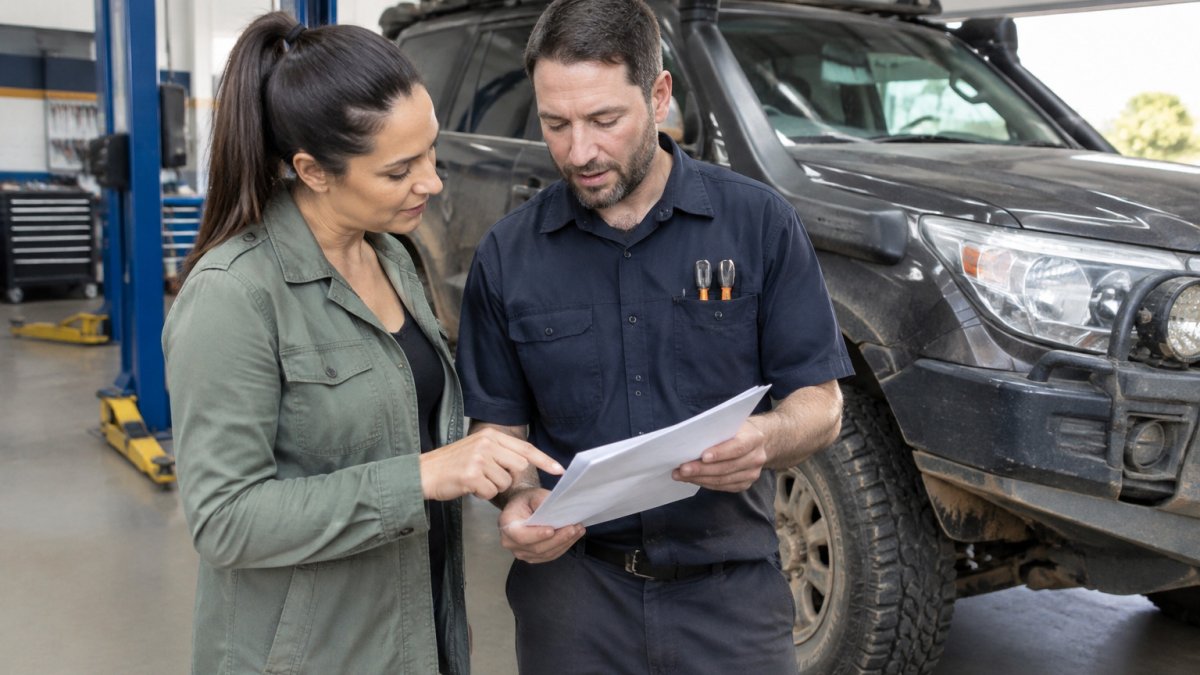
- Do you service my make and model regularly, and do you have the factory diagnostic software for it?
- Can you explain how you diagnose a fault before quoting, and will you show me the findings?
- Will I receive a written quote before any work starts, with parts and labour listed separately?
- What warranty do you offer on parts and labour, and how long does it run?
- How long will a typical service take, and will you call me before doing extra work?
- Do you have experience with modified 4WDs, including lifts, larger tyres, and accessory fitment?
- How do you record the work in my logbook, and will I get copies of every invoice?
Pay attention to how the mechanic responds. Clear, patient answers usually signal a trustworthy workshop. Evasive answers are a red flag.
A Practical Vetting and Comparison Checklist
Use the same checklist for each workshop so the comparison is fair. Score each item as you go rather than relying on memory.
- Confirm the trade qualification and current registration and insurance.
- Ask for the name of the technician who will work on your vehicle and how long they have worked on your model.
- Ask two technical questions specific to your vehicle, such as how they check the transfer case and how they set suspension geometry after a lift.
- Request a written quote and check that it lists parts, labour, and any assumptions or exclusions.
- Ask what happens if the diagnosis changes once the vehicle is on the hoist, and whether you will be called before extra work is approved.
- Confirm the warranty terms in writing, including whether they cover parts, labour, and aftermarket components.
- Ask how service records are kept and whether they will be entered into your logbook.
- Read recent reviews and ask for a reference from a customer with a similar vehicle and use.
Compare the quotes line by line. A cheaper quote that omits a transfer case fluid service or a brake inspection is not cheaper once the missing work is added. Watch out: a verbal estimate can change once work starts, so get everything in writing before you leave the vehicle.
Reading a Written Quote and Diagnostic Explanation
A good workshop will diagnose the fault before recommending a repair, and it will explain the diagnostic process step by step. Ask them to describe what they tested, what they found, and why the repair follows from the finding. If someone quotes a major repair without testing, be cautious.
The written quote should separate parts and labour, list the parts by brand or specification where it matters, and state any assumptions, such as whether a seized bolt may add labour.
If you suspect a serious fault, a vehicle diagnostics check can pinpoint the cause before any repair is quoted. A full safety inspection is also a useful step before a long trip.
The checklist below sets out what to compare across each workshop you consider, using the same criteria for each.
| Step | What to do | Note |
|---|---|---|
| Confirm credentials | Check trade qualification, registration and insurance | Before booking |
| Ask technical questions | Ask how they check transfer case and suspension geometry | Listen for specifics |
| Request written quote | Check parts, labour, assumptions and exclusions | Compare line by line |
| Confirm warranty | Get parts and labour terms in writing | Include aftermarket parts |
| Check extra-work policy | Ask whether you are called before extra work | Quote can change on the hoist |
| Review records | Ask how service records enter your logbook | Keep every invoice |
| Check references | Read reviews and ask for a similar-vehicle reference | Match your vehicle and use |
How 4WD Logbook Servicing Works and What It Should Include
Logbook servicing keeps your vehicle on the schedule set by the manufacturer. Keeping that record complete can matter for warranty claims, so it is worth doing correctly.
A thorough 4WD logbook service typically covers oil and filter changes, brake checks, and inspection of the drivetrain. Ask the workshop to show you the full list of what is checked and recorded.
Here is a simple way to think about what a service should cover:
- Check engine oil, filters, and all fluid levels
- Inspect brakes, tyres, and steering components
- Check transfer case and differential fluids
- Inspect suspension, driveshafts, and CV joints
- Record every task in the service logbook
Ask whether the service is done to the manufacturer’s schedule. If you want a service on a 4WD, you can book a logbook service or arrange 4WD servicing through our team at Northside Autocare.
Warning Signs, Diagnostics and Written Quotes
Some faults give clear warnings. Watch for grinding during 4WD engagement, vibration at speed, fluid leaks under the vehicle, or a warning light that stays on. Do not ignore them.
A good workshop will diagnose the fault before recommending a repair. Ask them to explain the diagnostic process step by step. If someone quotes a major repair without testing, be cautious.
Always ask for a written quote. It should list parts, labour, and any assumptions. Compare it with other quotes if the job is large.
If you suspect a serious fault, a vehicle diagnostics check can pinpoint the cause before any repair is quoted. A full safety inspection is also a useful step before a long trip.
Modifications, Warranty Implications and Your 4WD Repair Checklist
Modifications can improve handling and capability, but they can also affect warranty cover and safety. Lift kits, larger tyres, and aftermarket bars all change how the vehicle works. Keep records of every modification and the work that supports it.
Before any repair, use this checklist:
- Confirm the mechanic has 4WD and modified-vehicle experience
- Ask for a written quote with parts and labour listed
- Check the warranty on parts and workmanship
- Keep copies of all invoices and service records
- Ask how the work affects your vehicle warranty
- Schedule a suspension check if you have modified the vehicle
If your suspension feels loose or the ride has changed after modifications, you can schedule a suspension checkup to assess the setup.
Booking Your 4WD Service With Northside Autocare
Choosing the right mechanic takes a little effort, but it pays off in reliability and peace of mind. Look for relevant experience, clear communication, written quotes, and a willingness to explain each step.
Ready to get started? Book Your Service with Northside Autocare and let our team check your vehicle properly.
Frequently Asked Questions
How do I choose a reliable mechanic for my 4WD?
Start by checking whether the workshop regularly services 4WDs, not just passenger cars. Ask about the makes and models they work on, how long they have been working on 4WDs, and what training their technicians have completed. Look for recent customer reviews that mention 4WD work specifically, and ask for a written quote before any work begins. A workshop that explains the diagnosis clearly and puts its pricing in writing is usually a good sign.
Can I use an independent mechanic for logbook servicing?
Yes, in many cases you can. Check your vehicle’s warranty conditions and ask the mechanic to record each service in your logbook, including the date, kilometres and the parts or fluids used. Keep your receipts and itemised invoices. If you are unsure whether a service will meet the manufacturer’s requirements, confirm with the manufacturer or your dealer before booking, as the warranty conditions for your specific vehicle will govern.
How often should a 4WD be serviced?
Follow the service intervals in your owner’s manual, which set out the timing by kilometres and months. Off-road driving, towing, dusty conditions and long remote trips can mean you need more frequent checks, particularly for oil, filters, brakes, suspension and driveline components. A mechanic familiar with 4WDs can advise whether your use calls for a shorter schedule than the manual suggests.
What should a 4WD service include?
A typical 4WD service includes an oil and filter change and checks of the main systems your owner’s manual lists. Ask for a written list of what was checked, what was replaced and what needs attention soon, so you can compare it against your logbook requirements and plan future repairs.


