
Last Updated: November 8, 2026
Quick Summary
A failed car inspection means your vehicle did not meet the safety standards for road use, and it comes with a list of faults that each have a clear fix. Whether you can still drive the car depends on whether the faults are minor, major or dangerous.
- Read the full defect notice and write down each fault, its part and its category.
- Minor defects still need fixing but may allow driving; major defects often mean no driving until repaired.
- Dangerous defects usually mean the car must be towed or trailered to a repairer.
- Keep every repair receipt and invoice, because the re-inspection tester may ask for them.
- Confirm the recheck deadline and fee with the inspection station when you book the repairs.
Table of Contents
- What a Failed Car Inspection Actually Means
- Understanding Minor and Major Vehicle Safety Inspection Defects
- Step 1: Read Your Defect Notice and Note Each Item
- Step 2: Find Out Whether You Can Still Drive the Car
- Step 3: Get Repairs Done and Keep Your Receipts
- Step 4: Book a Car Inspection Recheck After Repairs
- Booking Your Re-inspection With Northside Autocare
- Frequently Asked Questions
What a Failed Car Inspection Actually Means
A failed car inspection means your vehicle did not meet the safety standards set for road use. A failed inspection is a list of faults, each with a clear fix.
Vehicle inspection requirements and defect categories
The most common reasons for failure include worn brake pads, tyres below the legal tread depth, cracked windscreens in the driver’s line of sight, and lights that do not work. See the most common faults that cause inspection failures A car can fail on a single item. It can also fail on several at once.
Many drivers are surprised by how small some faults are. A cracked indicator lens or a blown number plate light can stop a car from passing. These are cheap fixes, but they still count.
[PAGE: Common Reasons For Safety Inspection Failure | section:What a Failed Car Inspection Actually Means]
Understanding Minor and Major Vehicle Safety Inspection Defects
Inspection faults usually sit in two groups, but the exact labels and consequences depend on which state or territory issued the inspection. Minor defects are problems that do not stop the car from being driven safely, but they still need fixing. Major defects are problems that affect safety directly, such as failed brakes or steering play. A third category, dangerous or unsafe defects, applies when the car cannot be driven at all without risking a crash.
The difference matters because it changes what you can do next. A car with only minor defects may be allowed back on the road quickly. A car with major defects often must not be driven until the fault is repaired. A dangerous defect usually means the car must be towed or trailered to a repairer.
- Minor defects: worn wipers, a small chip in the windscreen outside the driver’s line of sight, a faint exhaust leak, a blown number plate light
- Major defects: brake fluid leaks, bald tyres, a seized suspension joint, cracked tie rod ends, steering play beyond the manufacturer’s limit
- Dangerous defects: anything that makes the car unsafe to drive at all, such as a failed brake circuit, a collapsed wheel bearing or a fuel leak
Vehicle inspection requirements and defect categories
Read your defect notice closely to see which group each item falls into. Diagnose what each listed fault actually is The category tells you how urgent the repair is and whether you can legally drive the car to a workshop. In some jurisdictions, a major defect notice requires the car to be repaired and re-inspected before it can be driven again, while a minor defect notice may allow you to drive to a nominated repairer within a set period.
A common pattern is that the same physical fault can be classified differently depending on the inspector and the jurisdiction. A worn tyre at the legal tread limit might be a minor defect in one inspection scheme and a major defect in another. That is why the notice itself, not a generic list, is the document that governs what you can do next.
If you are unsure which category applies, check the regulator’s website for your state or territory. Most regulators publish a defect category guide that explains what each label means and what you must do before driving again.
Step 1: Read Your Defect Notice and Note Each Item
Start by reading the full defect notice from the inspection station. It lists every fault the tester found. Do not skip any line, even the ones that look small.
Next, write down each fault in plain words. For each item, note the part, the problem and the category. Keep this list with your paperwork.
[PAGE: Diagnose Car Problems Before Repair | section:Step 1: Read Your Defect Notice and Note Each Item]
Many people find it helpful to ask the mechanic to show the faults on the car. Seeing a cracked tie rod or a worn pad in person makes the repair easier to understand.
The article sorts inspection faults into categories, which determine what you can do next.
| Defect category | Example | What it means |
|---|---|---|
| Minor | Worn wipers, blown number plate light | Does not stop safe driving, still needs fixing |
| Major | Brake fluid leaks, bald tyres | Affects safety directly, often no driving until repaired |
| Dangerous | Failed brake circuit, fuel leak | Car unsafe to drive, may need towing |
Step 2: Find Out Whether You Can Still Drive the Car
Next, check whether the car is legal to drive. This depends on the defect category and your state’s rules. A dangerous defect usually means the car must be towed or trailered to a repairer.
Driving with a failed inspection can bring fines. It can also affect your insurance if the car is involved in a crash. If you are unsure, do not drive the car until you have checked.
Step 3: Get Repairs Done and Keep Your Receipts
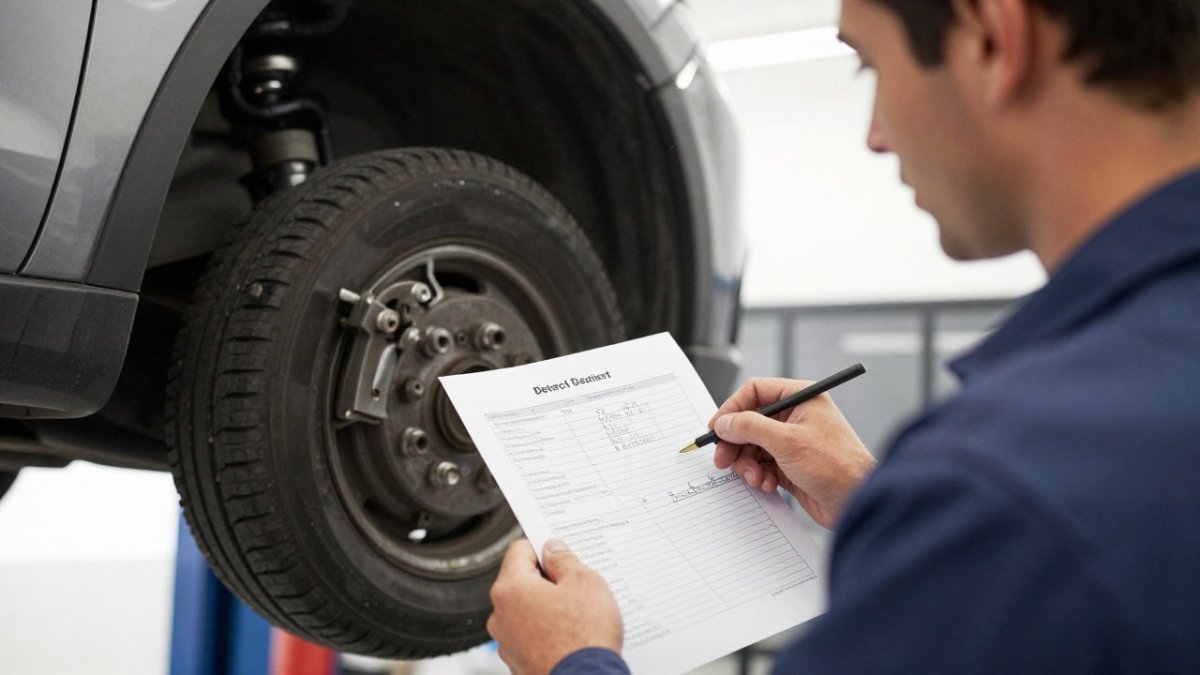
Once you know the faults, book the repairs. Ask for a quote for each item so you can compare costs. Keep every receipt and invoice, because you will need them for the re-inspection.
[PAGE: What Is Included In Logbook Service | section:Step 3: Get Repairs Done and Keep Your Receipts]
Repair costs depend on the fault, the make of the car and the parts needed. Ask your repairer to explain what each quote covers. See what a logbook service includes
Step 4: Book a Car Inspection Recheck After Repairs
After the repairs, book a re-inspection. The rules for rechecks vary by state and territory, so confirm the deadline and fee with the inspection station before you leave the repairer.
Bring your defect notice and repair receipts to the recheck. Learn how to book a recheck online and which documents to prepare This helps the tester see which faults were fixed.
A chronological checklist for the recheck:
- Confirm the recheck deadline and fee with the inspection station when you book the repairs.
- Keep every repair invoice and receipt, the tester may ask to see them.
- Book the recheck as soon as the repairs are finished, not on the last day of the window.
- Bring the original defect notice, the repair receipts and your vehicle registration papers.
- If the car fails again on a new item, ask for the new defect notice in writing and repeat the repair-and-recheck process.
If your registration renewal is due soon, check whether the failed inspection affects your ability to renew with your state or territory roads authority. Contact your state or territory roads authority to confirm how a failed inspection interacts with your renewal date.
[PAGE: Blog | section:Step 4: Book a Car Inspection Recheck After Repairs]
If you believe the inspection result was wrong, ask the station for its complaints or review process. Regulators may publish a process for disputing an inspection result; check with the regulator for your state or territory. Document your concerns in writing and keep copies of all correspondence.
Booking Your Re-inspection With Northside Autocare
If you need help with the repairs or the recheck, Northside Autocare can assist. Our team can talk you through the next steps.
Contact us to arrange a time that suits you. Get in touch with Northside Autocare to arrange a time
[PAGE: Contact Us | section:Booking Your Re-inspection With Northside Autocare]
Best for: drivers who have just received a defect notice and want the repairs and recheck handled in one place.
Skip if: your car has no listed defects and you only need routine servicing.
BUTTON: Book Your Re-inspection
CARD_TITLE: Failed your inspection?
CARD_TEXT: Northside Autocare handles repairs and re-inspection preparation in one visit.
Frequently Asked Questions
What happens if my car fails a safety inspection?
The inspector issues a defect notice listing each fault and whether it is minor or major. The vehicle is not automatically removed from the road, but you cannot treat it as roadworthy until the listed defects are repaired and it passes a re-inspection. Keep the notice, because it sets out what must be fixed and the deadline that applies in your state or territory.
Can I still drive my car after it fails an inspection?
It depends on the defects. Where the notice shows a major defect that makes the vehicle unsafe, driving it may be prohibited except to take it to a repairer or a re-inspection. Minor defects usually allow driving while you arrange repairs. Check the notice wording and the rules for your state or territory before driving.
Do I need to pay for another inspection after repairs?
Often yes, but not always. Ask the inspection station what applies to your case, and keep the repair invoices, since they show what was fixed and help the tester confirm the work.
Does a failed inspection affect my car registration?
Rules differ across Australia, so check with your state or territory transport authority about the deadlines and what evidence you need to show before your registration expires.


