

Last Updated: November 16, 2026
Quick Summary
A car battery replacement cost in 2026 depends on battery chemistry, your vehicle’s electrical demands, and whether a workshop fits it or you do it yourself, so expect a range rather than one figure. AGM batteries cost more upfront than standard lead-acid units but suit modern start-stop vehicles. Always get an itemised fitted quote covering the battery, labour, charging check and disposal.
- AGM batteries hold charge better and tolerate deeper discharge than standard lead-acid units.
- A fitted quote should itemise the battery, labour, terminal cleaning, charging check and disposal.
- Many modern vehicles need the new battery registered to the engine control unit after fitting.
- Load testing and a charging system check reveal whether replacement is even necessary.
- Battery access difficulty and group size both shift labour and parts costs.
Table of Contents
- Car Battery Replacement Cost in 2026: The Ranges That Matter
- AGM Car Battery Cost vs Standard Lead-Acid
- What Car Battery Fitting Cost Actually Covers
- Car Battery Replacement Time: Workshop, Mobile or DIY
- The Car Battery Test That Decides Whether You Pay at All
- What Drives Your Quote Up or Down
- Book a Battery Test and Fitted Quote at Northside Autocare
- Frequently Asked Questions
Car Battery Replacement Cost in 2026: The Ranges That Matter
A car battery replacement cost in 2026 is not a single number, and any guide that hands you one figure is guessing. What you actually pay depends on battery chemistry, your vehicle’s electrical demands, and whether a workshop does the job or you do it yourself. The honest answer starts with ranges rather than a headline price.
Most drivers only think about the cost when the engine won’t turn over.
The gap between those two ends is wide, and it is driven by things you can control.
Below, we break down what actually moves the number, how to compare quotes fairly, and when a test should come before a purchase.
AGM Car Battery Cost vs Standard Lead-Acid
AGM car battery cost sits meaningfully above a standard lead-acid unit, and there is a reason. Absorbent Glass Mat batteries hold their charge better, tolerate deeper discharge, and support the electrical load that modern start-stop systems demand. A standard flooded battery is cheaper to buy but has a shorter realistic service life in a vehicle with heavy electrical demand.
Here is how the two compare on the factors that decide your quote:
| Factor | Standard Lead-Acid | AGM |
|---|---|---|
| Upfront cost | Lower | Higher |
| Start-stop compatibility | Usually not suitable | Designed for it |
| Cycle tolerance | Limited | Better |
| Typical service life | Shorter in demanding use | Longer |
| Best for | Older, simple vehicles | Modern start-stop and accessory-heavy vehicles |
Fitting the wrong chemistry to save money is a false economy. A standard battery in a start-stop vehicle will degrade faster than its warranty period, and you will be back at the counter sooner.
What Car Battery Fitting Cost Actually Covers
Car battery fitting cost is more than the price of the box, and the only way to compare quotes fairly is to see each line separately. A fitted quote should itemise the battery itself, labour to remove and install it, terminal cleaning and protection, a charging system check, and safe disposal or recycling of the old unit. When a quote looks unusually cheap, one of those items is usually missing.
A typical itemised fitted quote for a standard petrol vehicle breaks down roughly like this:
| Line item | What it covers | Typical share of the fitted price |
|---|---|---|
| Battery (standard flooded) | The part itself, matched to group size and cold cranking amps | Largest single line |
| Battery (AGM or start-stop) | Higher-spec part for start-stop or accessory-heavy vehicles | Largest single line, above flooded |
| Labour | Remove and refit, terminal clean and protect, hold-down check | Modest fixed line |
| Charging system check | Alternator output and voltage-drop verification after fitting | Small line, often bundled |
| Disposal or recycling | Collection and recycling of the old battery, or a core charge | Small line |
| Diagnostic or registration | Fault scan, memory preservation, battery management system registration where required | Variable, model-dependent |
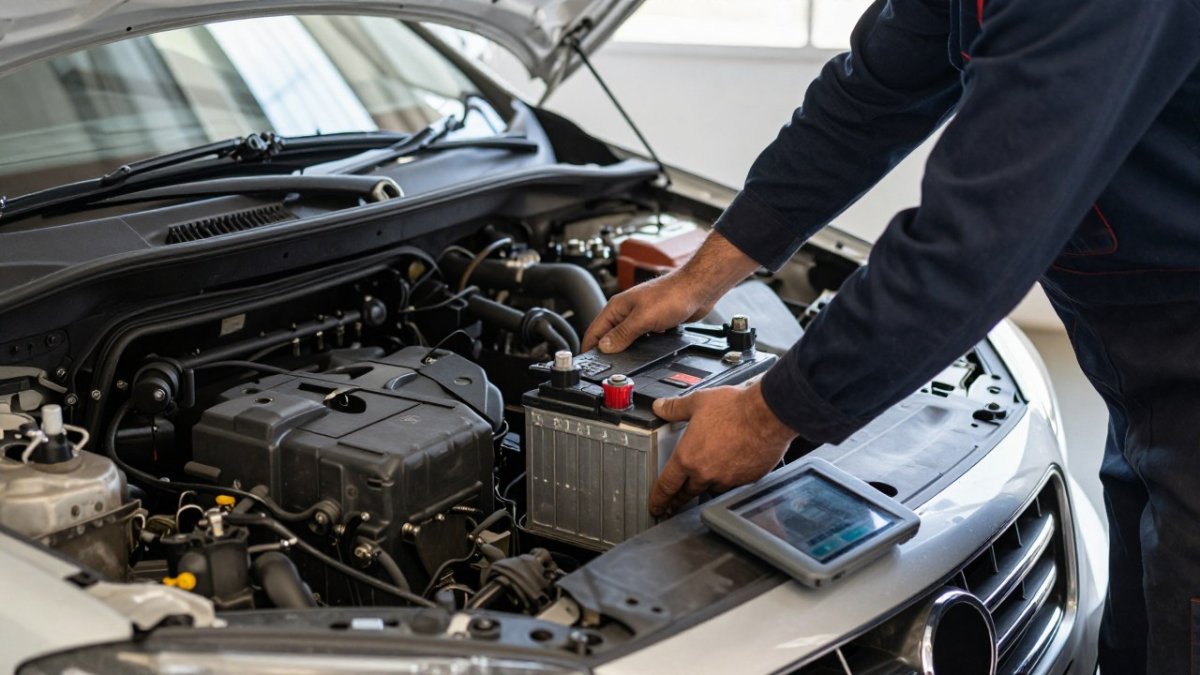
Parts versus installation is the split most drivers underestimate. The battery is the dominant cost, but labour, the charging check and disposal are what separate a fitted price from a parts-only price. A quote that bundles everything into one number hides whether you are paying for a genuine specification match or a cheaper unit with the difference absorbed into labour.
Watch out: a quote that excludes disposal or a charging system check is not a like-for-like comparison. Ask what happens to the old battery, whether a core charge applies, and whether the alternator output is verified after fitting.
Battery registration and vehicle electronics can add labour on many modern vehicles. Where the vehicle uses a battery management system, the new battery may need to be registered or coded so the charging strategy adjusts to its age and capacity. Memory preservation for radio codes and seat settings is a smaller but real line on some models. Ask whether registration is included before you compare two fitted prices, because a quote that omits it is not the same job.
If your vehicle is under a new-car warranty, fitting and any related repairs should follow the manufacturer’s schedule. Our guide on how to maintain your new car warranty requirements explains what to check before you authorise work.
Car Battery Replacement Time: Workshop, Mobile or DIY
Car battery replacement time depends entirely on which route you choose. Mobile fitting adds travel logistics. DIY takes the longest because you are sourcing the part, checking compatibility, and handling disposal yourself.
The trade-offs are worth spelling out:
Battery registration matters more than most drivers realise. Many modern vehicles need the new battery registered to the engine control unit so the charging system adjusts its output. Skip that step and a brand-new battery can be undercharged or overcharged, shortening its life. That is a cost hidden inside the “cheap” option.
The Car Battery Test That Decides Whether You Pay at All
A car battery test is the step that tells you whether replacement is even necessary. Load testing, a state-of-charge reading, and a charging system check separate a genuinely failing battery from a loose terminal, a failing alternator, or a parasitic drain. Replacing a healthy battery because of a starting problem wastes money and leaves the real fault in place.
Our vehicle diagnostics service exists for exactly this reason. We test before we recommend, so you are paying for a solution rather than a guess.
The symptoms that justify a test include slow cranking, dimming lights at idle, a battery warning light, or a battery that has passed its expected service life. Cold cranking amps and reserve capacity readings tell the technician how much capacity is actually left, not just whether the car starts today.
What Drives Your Quote Up or Down
Several factors move a battery quote, and understanding the mechanism behind each one helps you judge whether a price is fair rather than merely different.
Vehicle size and engine bay layout affect labour time. A battery tucked under a seat, behind a wheel-arch liner or beneath a cabin trim panel takes longer to access than one sitting open at the front of the bay, and that access difficulty shows up as labour rather than parts. Battery group size and capacity determine the part cost: a physically larger case with higher cold cranking amps and reserve capacity costs more than a smaller unit, and fitting the wrong group size is a false economy because the hold-down and terminal alignment will not match.
Start-stop and hybrid systems often require AGM or specialised batteries, which lifts the parts line. Standard flooded lead-acid is cheaper upfront but degrades faster under the deeper cycling that start-stop demands, so the lower purchase price can be offset by a shorter service life. Regional pricing and supplier availability shift the parts figure as well, and a part that is in short supply locally may carry a premium or a wait.
Comparing quotes fairly means matching the specification, not just the bottom line. A quote for a standard battery against a quote for an AGM unit is not a comparison at all. Ask each workshop to itemise the battery, labour, disposal, registration and any testing included, and to state the battery group size and chemistry in writing.
On methodology: the ranges in this guide are indicative fitted estimates for common passenger vehicles, expressed in Australian dollars, and they are intended to show the shape of the market rather than a fixed price for any one model. Treat any single figure as a starting point for a written quote, not a substitute for one.
If you want broader context on what mechanical work costs, our car mechanical repair price guide for Australian drivers covers how quotes are built across common jobs.
Book a Battery Test and Fitted Quote at Northside Autocare
Guessing at a battery cost is how drivers end up paying twice. The reliable path is a proper test, a clear fitted quote, and a workshop that recycles the old unit and checks your charging system before you drive away.
You can review our batteries service and arrange a fitted quote, or use our contact details to book a battery test at a time that suits you.
A failing battery rarely announces itself politely. It fails on a cold morning when you need the car most. Get it tested properly, get a fitted quote that itemises what you are paying for, and let a workshop with real diagnostic equipment confirm the fault before you spend. Get started with Northside Autocare and book a battery test with a fitted quote today.
Frequently Asked Questions
How much does it cost to replace a car battery in 2026?
Battery cost depends on the battery type, engine size and how the battery is fitted, so the most reliable answer is a written quote. For current prices, visit the Northside Autocare website. Battery type, engine size and how the battery is fitted change the number far more than the year does. Ask for an itemised fitted price so parts and labour are separated.
What is included in a car battery replacement quote?
A properly itemised quote lists the battery itself by group size and capacity, the labour to remove and refit it, terminal clean and protection, disposal of the old battery, and any computer reset or battery registration your vehicle needs. Some cars also need a diagnostic scan before and after. Ask whether the price is fitted and whether the old battery is taken away. If a quote is a single lump sum with no breakdown, ask for the parts and labour split before you approve the work.
How much does an AGM car battery cost compared with a standard battery?
AGM batteries cost more because they are built for start-stop systems and heavier electrical loads. The gap is real, but fitting a cheaper standard battery to a start-stop vehicle can shorten its life and cause repeated warnings. Match the battery to what the vehicle was built for rather than to the lowest price on the shelf.
Does fitting a car battery cost extra?
Often yes, and it pays to check before you book. Some advertised prices are for the battery alone, with labour added on top, while fitted prices include removal, refit and disposal. Fitting is usually quick on a conventional car, but vehicles with the battery under a seat, in the boot or behind a guard liner take longer and cost more in labour. Ask directly whether the quoted figure is fitted or parts only, and whether old battery disposal is included.
How do I know if my car battery needs replacing or just needs a test?
Slow cranking, dimming lights, repeated jump starts and a battery warning light are signs worth testing, not automatically replacing. A load test measures how the battery holds voltage under demand, and a charging system check shows whether the alternator is doing its job. Plenty of batteries are replaced when the real fault is a loose terminal or a failing alternator. Get a test first, then decide. A battery that passes on a cold morning is cheaper than a new one you did not need.


