
Last Updated: November 1, 2026
Quick Summary
A logbook service is a scheduled service done at the intervals in your vehicle’s service booklet. It typically includes scheduled replacements such as engine oil and the oil filter, plus inspections and fluid top-ups, all recorded in your logbook.
- Engine oil and the oil filter are replaced at the scheduled interval, using the grade in your booklet.
- Each service is recorded in your logbook with the date, odometer reading and stamp.
- Inspections check items like brakes and tyres, and are only replaced if faulty or worn.
- Confirm the invoice lists the oil specification and every scheduled replacement before paying.
Table of Contents
- What a Logbook Service Is and Why It Matters for Your Warranty
- Core Items Checked and Replaced in a Logbook Service
- Logbook Service Checklist: Inspected Versus Replaced
- Logbook Service vs Basic Service: What Separates Them
- How Logbook Service Intervals Are Set by Make, Model and Mileage
- Choosing an Independent Mechanic for Your Logbook Service
- Booking Your Next Logbook Service at Northside Autocare
- Frequently Asked Questions
Every logbook service follows a set list of checks, and knowing that list helps you judge whether a mechanic has done the job properly. A complete logbook service follows the manufacturer’s schedule, and the sections below set out what it typically covers. The exact items depend on your vehicle, so always check your own service booklet as well.
What a Logbook Service Is and Why It Matters for Your Warranty
A logbook service is a scheduled service carried out at the intervals set out in your vehicle’s service booklet. It covers the checks and replacements the manufacturer specifies to keep the car running as designed.
Keeping a stamped service record can matter for warranty purposes, as many manufacturers ask for evidence of servicing to schedule. Check your own warranty booklet for the exact requirements.
- The service is recorded in your logbook with the date, odometer reading and stamp
- Some warranty claims ask for proof of regular servicing
- Missed services can leave you covering the cost of a later repair
Core Items Checked and Replaced in a Logbook Service
Most logbook services include a set of replacements and a set of inspections. Replacements are parts or fluids swapped on a fixed schedule. Inspections are visual or measured checks that decide whether a part needs attention now.
Engine Oil and Oil Filter Replacement
Fresh engine oil and a new oil filter are the core of almost every logbook service. The oil grade must match the manufacturer specification, not just whatever is cheapest on the shelf.
Always check the specification listed in your service booklet.
Fluid Levels: Coolant, Brake and Transmission Fluid
Fluids such as coolant, brake fluid and, where fitted, transmission fluid are typically checked during a logbook service.
- Coolant: checked for level and condition to protect the cooling system
- Brake fluid: checked for level, and the condition is assessed, since it absorbs moisture over time
- Transmission fluid: checked where the design allows, following the manufacturer’s method
Logbook Service Checklist: Inspected Versus Replaced
Most logbook services combine two very different kinds of work: items the manufacturer says to replace at that interval, and items a technician inspects and only replaces if a fault or wear limit is found. Confusing the two is the single most common reason drivers feel a logbook service was either overpriced or incomplete.
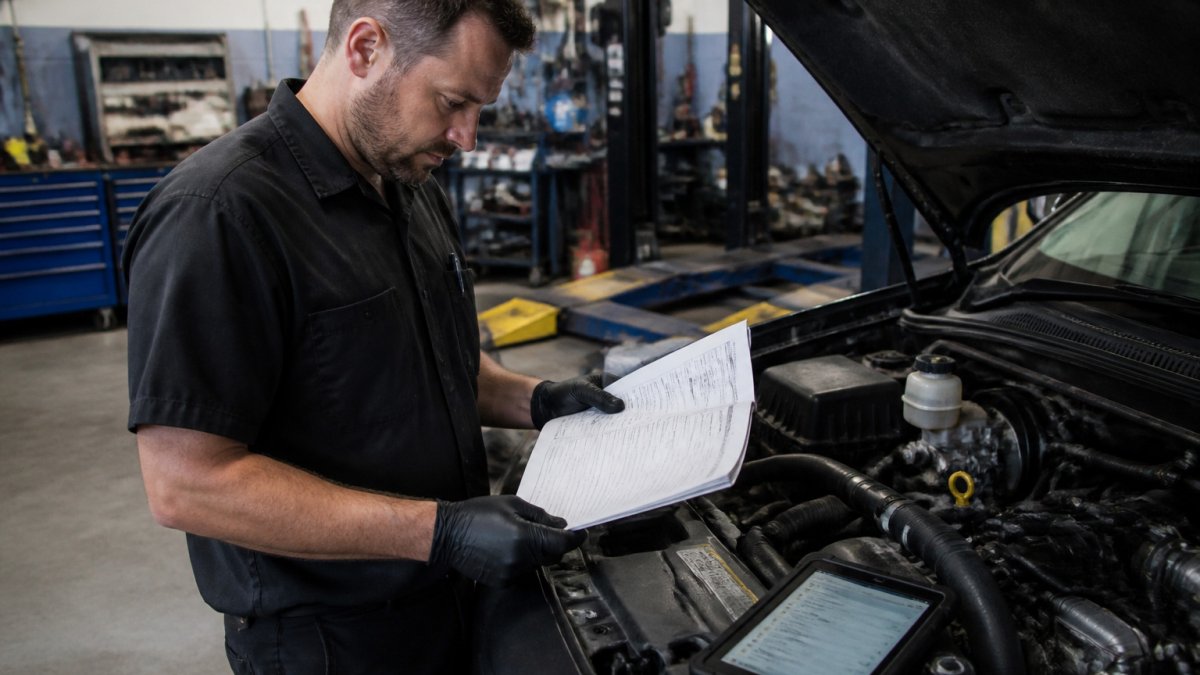
The usual split for a standard interval
The table below shows the typical pattern. Treat it as a guide only, your service booklet overrides it item by item.
| Category | Typical items | What happens |
|---|---|---|
| Scheduled replacement | Engine oil, oil filter, air filter (at specified intervals), spark plugs (at specified intervals), cabin filter (where listed), brake fluid (time-based on many schedules) | Swapped as a matter of course, whether or not the old part looks worn |
| Inspection and adjustment | Brake pads and discs, tyres and tread depth, battery condition, steering and suspension, belts and hoses, cooling system, exhaust, lights, wipers | Measured or visually checked; replaced only if outside the manufacturer’s wear limit or faulty |
| Level check and top-up | Coolant, brake fluid, transmission fluid (where the design allows), power-steering fluid (where fitted), washer fluid | Topped up to specification; condition noted |
A quick way to sanity-check a quote: ask the shop which items on your manufacturer’s schedule for this interval are replacements and which are inspections.
Why the same service looks different on two cars
A 30,000 km service on a small hatchback and a 30,000 km service on a diesel ute can share almost nothing beyond oil and a filter. The manufacturer’s schedule is written per model, per engine and per market, and it changes with age and mileage. Items that appear at one interval, spark plugs, cabin filters, brake fluid, timing belts on older engines, may be absent at the next.
What a proper logbook entry should record
When the service is finished, the record in your booklet (and the itemised invoice that should accompany it) ought to show enough detail that a future buyer or warranty assessor can verify the work. A complete entry typically includes:
- Date of service and odometer reading at the time
- Service interval claimed (for example, the 45,000 km / 36-month service)
- Work performed, itemised, not just “full service”
When an inspection finds a fault
An inspection that turns up a worn brake pad or a leaking hose does not automatically mean the logbook service was mispriced. Any additional repair should be quoted separately, with parts and labour broken out, and approved by you before the work proceeds.
Additional repairs identified during a logbook service are not part of the scheduled service. They should appear as a separate line on the quote and invoice. If a shop bundles unrequested repairs into the logbook price without approval, ask for the itemised breakdown before you pay.
How to verify the service was done to specification
You do not need to be a mechanic to check the basics. Before you drive away, confirm:
- The invoice lists the oil specification and matches the grade in your booklet.
- Every scheduled replacement for this interval appears on the invoice.
- The logbook is stamped and the odometer reading is correct.
If any of those are missing, ask for them to be corrected before you sign off. A logbook service is only as valuable as the record it leaves behind.
Logbook Service vs Basic Service: What Separates Them
A basic service is a shorter check, often oil and a visual inspection. A logbook service follows the full manufacturer schedule and is recorded in your service booklet.
The difference matters most for warranty. A basic service may be fine for general upkeep, but a logbook stamp proves the manufacturer’s full schedule was followed at the right interval.
How Logbook Service Intervals Are Set by Make, Model and Mileage
There is no single national service interval. Each manufacturer publishes a maintenance schedule for each model, engine and model year, and that schedule, not a generic “every 10,000 km” rule, is what a logbook service is measured against.
Where the interval actually comes from
The schedule in your service booklet is set by the manufacturer and typically specifies both a distance and a time limit, whichever comes first. Common patterns include:
- 10,000 km or 12 months, still used on many older and some current models
- 15,000 km or 12 months, common on a wide range of passenger cars and SUVs
- 20,000 km or 12 months, increasingly common on newer engines with longer-drain oils
Those figures are illustrative of common patterns, not a substitute for your booklet. The exact numbers for your vehicle are printed there, and they can differ between the petrol and diesel versions of the same model.
Why two cars of the same age need different services
Interval alone does not determine what is done. The schedule is also indexed by odometer reading, so a vehicle at 60,000 km will typically have a different item list from the same model at 30,000 km, even if both are serviced 12 months apart. Age matters too: some items are time-based (brake fluid, coolant on certain schedules) and some are distance-based (spark plugs, filters).
A practical example of how the same model can diverge:
| Vehicle state | Likely emphasis at the next service |
|---|---|
| 3 years old, 25,000 km, mostly city driving | Oil and filter, brake fluid if time-due, cabin filter, brake inspection |
| 6 years old, 90,000 km, mixed highway | Oil and filter, spark plugs if scheduled, transmission fluid if listed, coolant condition, suspension inspection |
| 10 years old, 180,000 km, towing | All of the above plus closer attention to cooling system, belts, hoses and transmission behaviour |
The single most useful thing you can do before booking is find the page in your service booklet that covers your current odometer reading and date, and note which items are marked as replacements at that interval. That list, not a generic checklist, is what a proper logbook service should be quoted against.
Severe-use conditions that shorten the interval
Many manufacturers publish a separate “severe” or “arduous” schedule for vehicles used in demanding conditions. Common triggers include:
- Frequent short trips where the engine does not reach operating temperature
- Sustained towing or heavy loads
- Regular driving on unsealed or dusty roads
Under those conditions the booklet may call for more frequent oil and filter changes, earlier inspections, or additional items. If your driving matches any of them, mention it when you book so the shop can quote against the correct schedule.
How to find and confirm your interval
- Locate the maintenance schedule section of your service booklet (often a table by distance and months).
- Identify the row for your current odometer reading and the months since the last service.
- Note every item marked as a replacement at that row, and every item marked as an inspection.
- Check whether the booklet lists a severe-use schedule that applies to you.
- Compare that list against any quote you receive, the quote should reference the same interval.
If the booklet is missing, most manufacturers can supply the schedule for your vehicle identification number (VIN) through a dealer or their customer service line. Keep a note of the interval you booked against, because it is the reference point for verifying the completed service. If you are curious how fault codes are read during a service, you can learn vehicle diagnostic tools for reading fault codes.
Choosing an Independent Mechanic for Your Logbook Service
An independent mechanic can carry out a logbook service, provided the work follows your manufacturer’s specification and is recorded properly in your booklet. To weigh this choice, compare logbook service at an independent mechanic versus a dealership, including warranty rules, typical costs and the records to keep.
It also pays to compare quotes from more than one shop before booking. Ask each one for a written breakdown of what is included. You can also get a logbook service quote quickly and compare pricing from multiple mechanics before choosing.
Booking Your Next Logbook Service at Northside Autocare
Logbook servicing for cars, trucks and caravans is available from Northside Autocare. Visit the website for details of what is included.
To book, contact Northside Autocare through the website. Current pricing depends on your vehicle and the service due, so please request a quote directly. Before you book, see how long a logbook service takes so you can plan your time.
Frequently Asked Questions
Should I get a logbook service or a basic service?
A logbook service follows the manufacturer’s schedule and is recorded in the vehicle’s service logbook, which is what most new-car warranties require. A basic service is a lighter check, typically oil and filter changes with a visual inspection, and it may not be recorded to the manufacturer’s specification. If your car is still under warranty, a logbook service is the safer choice. Check your owner’s manual for the service interval and the items it lists, then confirm with the workshop that the stamp and record will meet those requirements before you book.
Does a logbook service include an oil and filter change?
Yes. Engine oil and oil filter replacement is a core item in a logbook service, and the oil grade must match the manufacturer’s specification in your owner’s manual. The workshop should record the date, odometer reading and the oil type used in the service logbook. Using the wrong oil grade can affect warranty claims even when the change itself was done, so ask the mechanic to confirm the grade they used. Filter replacement follows the same logic and should be noted alongside the oil change.
Can an independent mechanic perform a logbook service?
In most cases, yes. An independent mechanic can complete a logbook service provided the work follows the manufacturer’s schedule, uses correct parts and fluids, and is documented in the logbook with the date, odometer reading and the items completed. Ask whether the workshop records each service item and what evidence it provides, such as an itemised invoice. Keeping receipts for parts and fluids helps demonstrate that the service met manufacturer specifications if a warranty question arises.
How often should I get a logbook service?
Logbook service intervals depend on the make, model, age and how the vehicle is driven. Most manufacturers specify a schedule by time or distance, such as every 12 months or 15,000 km, whichever comes first. Your owner’s manual or service book sets out the exact intervals for your vehicle. Severe use, such as frequent short trips, towing or dusty conditions, may call for more frequent servicing, so check whether your manual lists a severe-use schedule as well.


