

Last Updated: October 28, 2026
Quick Summary
An independent mechanic can usually carry out a logbook service without automatically voiding your new-car warranty, according to Practical Motoring, though you should check your warranty booklet first. The deciding factors are your warranty conditions, whether a recall or capped-price plan applies, and whether the workshop’s records and parts meet the manufacturer’s specification.
- Warranty conditions usually require servicing at the manufacturer’s intervals and proof that the work was done.
- A dealership is usually safer for open recalls, capped-price service plans and complex electronic faults.
- Before booking, ask which schedule item number the job covers and whether parts meet manufacturer specification.
- Compare quotes line by line, including labour, oil specification, filters and inspection items.
Table of Contents
- Does Independent Servicing Void Warranty in Australia?
- What a Logbook Service Actually Includes
- Logbook Service Checklist: Confirming Every Item Is Done
- Independent Mechanic vs Dealership: Pros and Cons
- Comparing Costs Like for Like
- Keeping Service Records That Protect Your Warranty
- Booking Your Next Logbook Service at Northside Autocare
- Frequently Asked Questions
Choosing between an independent mechanic and a dealership for your logbook service is one of the most common decisions Australian car owners face. Northside Autocare provides manufacturer-approved logbook servicing. The short answer is that an independent workshop can usually carry out a logbook service without voiding your new-car warranty, but the details matter.
Does Independent Servicing Void Warranty in Australia?
Generally, no. A non-dealer mechanic can perform a logbook service without automatically voiding a new car’s warranty, according to Practical Motoring’s guide to dealer versus non-dealer car servicing. The publication’s guidance is not a legal ruling, so check your own warranty booklet before booking.
Warranty conditions usually ask for two things: servicing at the intervals the manufacturer sets, and proof that the work was done. Keep that in mind when you choose a workshop. A consumer guarantee under Australian Consumer Law is separate from the manufacturer’s warranty, and it is worth understanding both. The ACCC’s guidance on consumer guarantees explains your rights when a service or repair fails to meet a reasonable standard.
What a Logbook Service Actually Includes
A logbook service follows the schedule in your vehicle’s service book. It typically covers oil and filter changes, a check of fluid levels, brakes, tyres, belts, lights, and a range of inspection points. The exact list varies by make and model, so the service book is your reference.
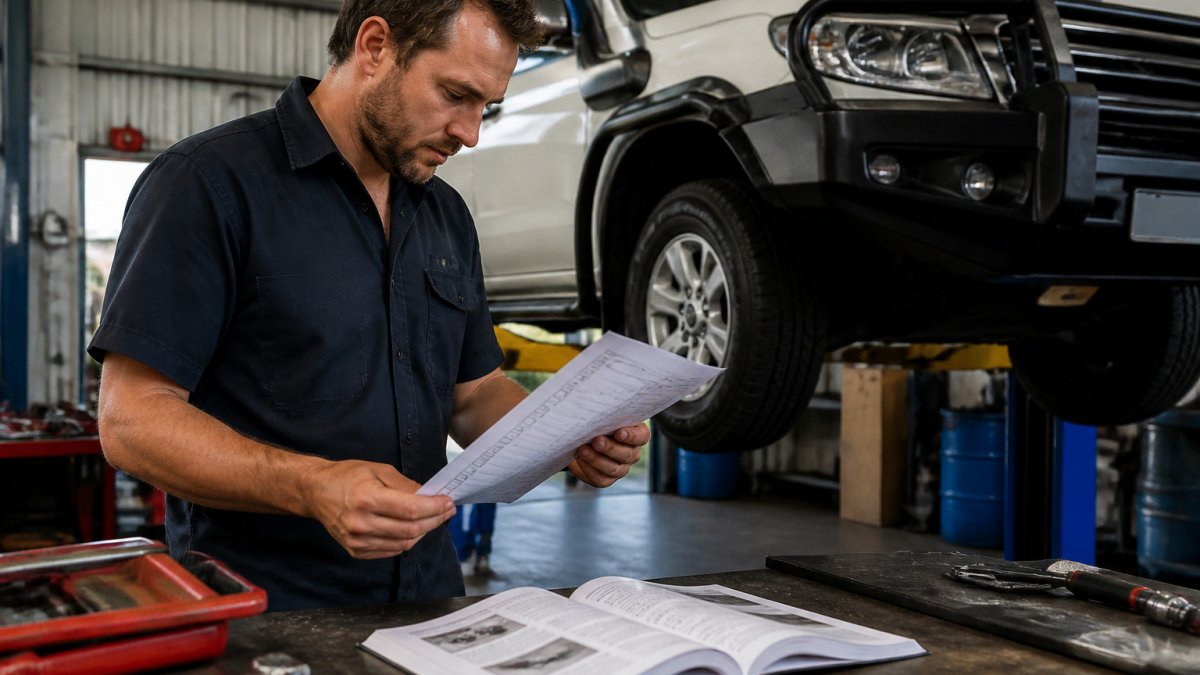
At Northside Autocare, our logbook servicing follows the manufacturer’s schedule. Ask any workshop to show you the checklist it works from before the car goes on the hoist.
Logbook Service Checklist: Confirming Every Item Is Done
Before you collect your car, check that the job matches the schedule. Use this list:
- Engine oil and filter replaced, with the correct grade for your vehicle
- Fluid levels topped up: coolant, brake, power steering and washer fluid
- Air and cabin filters inspected or replaced as the schedule requires
- Brake pads, discs and lines checked for wear and leaks
- Tyre pressures, tread depth and wheel condition checked
- Drive belts, hoses and battery tested
- Lights, wipers and horn working
- Service book stamped and dated, with the odometer reading recorded
A full logbook service usually takes a few hours, though minor services can be quicker. If a workshop cannot tell you how long the job will take, ask why.
Independent Mechanic vs Dealership: Pros and Cons
Neither option is right for every car, and the honest answer depends on your vehicle, your warranty status and what you plan to do with the car. The table below sets out the trade-offs that actually change the decision, rather than the generic list most guides repeat.
| Factor | Independent mechanic | Dealership |
|---|---|---|
| Labour rate | Usually lower hourly rate; ask for the rate in writing | Usually higher hourly rate; capped-price plans can narrow the gap on older vehicles |
| Parts and fluids | Can source OEM or equivalent parts that meet the manufacturer’s specification | OEM parts by default; specification is guaranteed to match the schedule |
| Diagnostic access | Good for common faults; may lack manufacturer-level scan tools for deep module faults | Direct access to manufacturer diagnostic software, service bulletins and software updates |
| Recalls and campaigns | Can perform recall work only if the manufacturer authorises the workshop | Handles recalls and service campaigns directly |
| High-voltage and complex vehicles | Varies widely; confirm technician training and tooling before booking | Factory-trained technicians and high-voltage tooling are standard |
| Booking flexibility | Often same-week or next-day; smaller workshops can be more flexible | Can be booked out further ahead, especially for popular models |
| Continuity | The same technician may look after your car for years | Technician rotation is common; records stay with the dealer |
| Records | Invoice and service book stamp; quality depends on the workshop’s process | Standardised digital service history tied to the VIN |
When the dealership is the better choice
A dealership is usually the safer pick in these situations:
- The car is under a capped-price service plan. If the capped price is close to an independent quote, the dealer’s manufacturer-level access and standardised records are effectively free.
- A recall or service campaign is open. Recall work is coordinated through the manufacturer’s network, and a dealer can complete it alongside the logbook service.
- The fault is complex or intermittent. Manufacturer scan tools and technical bulletins give dealers an information advantage on module, transmission and driver-assistance faults.
- The vehicle is high-voltage or highly specialised. Confirm the independent workshop’s high-voltage training and insurance before booking; not all workshops are equipped.
- You are selling soon and want a dealer-stamped history. Some buyers place a premium on a dealer service history, though a complete independent history with itemised invoices is generally just as strong.
When the independent is the better choice
An independent workshop is usually the better pick when:
- The warranty has expired and you are paying for the service yourself.
- The quote is genuinely like-for-like, same schedule items, same specification parts and fluids, and materially lower.
- You value continuity and want one technician who knows the car’s history.
- The car is older or a second vehicle where dealer-specific tooling adds little.
The main risk to your warranty is not the choice of workshop, it is missing, late or incomplete service records. A missed interval or an invoice that does not show the correct oil specification is a bigger threat than a dealer stamp.
Whichever you choose, ask the workshop two questions before booking: which schedule item number from your service book the job covers, and whether the parts and fluids meet the manufacturer’s specification. A workshop that cannot answer both is not a safe choice for a logbook service.
Comparing Costs Like for Like
Most cost comparisons fail because the two quotes are not for the same job. A cheaper headline price often reflects a shorter schedule, a lower-grade oil, or inspections that were skipped rather than performed. The method below is the one to use when you have two or three quotes in front of you.
Step 1: Anchor both quotes to the same schedule item
Your service book lists intervals by kilometre or time, and each interval has a specific set of tasks. Ask each workshop to state, in writing, which interval and which schedule item number its quote covers. If one quote is for a minor service and the other for a major service, the prices are not comparable and the comparison should stop there.
Step 2: Normalise the line items
Ask for the quote broken into these lines, and compare them one by one:
- Labour: hours quoted and hourly rate, shown separately.
- Engine oil: brand, viscosity grade and specification (for example, the manufacturer’s required specification code), and the quantity.
- Oil filter, air filter, cabin filter: part number or OEM/equivalent status.
- Brake fluid, coolant and other fluids: specification and whether replacement or top-up is included.
- Inspection items: whether the schedule’s inspection points are included or charged as extras.
- Consumables and disposal: whether these are included or added at the end.
- GST: confirm every quote is GST-inclusive before comparing.
A quote that lists only a total price cannot be compared like for like, and a workshop that will not itemise is telling you something about how it works.
Step 3: Check the specification, not just the price
A cheaper oil that does not meet the manufacturer’s specification can affect both warranty compliance and engine protection. The same applies to filters and fluids. If a quote is materially cheaper, the first question is which line item was downgraded, not whether the workshop is simply more efficient.
Ask each workshop to confirm in writing that the parts and fluids used meet the manufacturer’s specification for your vehicle. A workshop that does this routinely will answer without hesitation.
Step 4: Add the costs the headline price hides
Two quotes can differ by more than the service price:
- Travel and time off the road: a workshop further away or without a loan car or courtesy transport adds real cost.
- Upselling: a low headline price followed by a long list of recommended extras at pickup is a common pattern; ask what is included before you book.
- Repeat visits: if a workshop cannot complete a scheduled inspection because it lacks the tooling, you may pay twice.
- Record quality: a cheap service with a vague invoice can cost more at resale than the saving at the counter.
Step 5: Compare the total cost of ownership, not one service
Add up the quoted prices across the next two or three scheduled services, not just the next one. Capped-price plans and independent workshop pricing can cross over as the vehicle ages and the services get larger. A workshop that is cheaper on a minor service is not necessarily cheaper on a major one.
Keeping Service Records That Protect Your Warranty
Your service book is the most important document you own for warranty purposes. Keep every invoice, record the date and odometer reading at each visit, and keep receipts for any parts or fluids. If you sell the car later, a complete service history also supports its resale value.
Some owners worry that using an independent workshop leaves a gap in the paperwork. As long as each service is stamped in the book and the invoice shows what was done, the record stays complete. If anything is unclear, ask the workshop to note it on the invoice before you leave.
Booking Your Next Logbook Service at Northside Autocare
Northside Autocare provides logbook servicing, safety certificates and specialised 4WD work for cars, trucks and caravans. If you have questions about your warranty or your service schedule, book your logbook service. You can also see how we handle RWC and COI certificates if your car needs one alongside its service.
Frequently Asked Questions
Can an independent mechanic complete a logbook service?
Yes, in most cases an independent mechanic can carry out a logbook service, provided it follows the manufacturer’s service schedule and specifications for your model. Check that the work is recorded in your logbook or an itemised invoice showing the date, odometer reading, tasks performed and parts used. Ask whether the mechanic has experience with your make and whether the service meets the manufacturer’s requirements. If your car is still under its new-car warranty, confirm the service conditions in your warranty booklet before booking.
Will using an independent mechanic void my new-car warranty?
Using an independent mechanic does not automatically void a new-car warranty in Australia. What matters is whether the service follows the manufacturer’s schedule and uses parts and fluids that meet the specifications in your owner documentation. Keep detailed records of every service, including receipts for parts. Read your warranty conditions or check with the manufacturer if you are unsure.
Is dealership servicing more expensive than using an independent mechanic?
The difference depends on the make, model, parts used and the work included. Compare quotes for the same itemised list of tasks, parts and fluids rather than a headline price. Pricing varies with the vehicle and the scope of work, so contact Northside Autocare directly for a quote on your specific car.
What records should I keep after an independent logbook service?
Keep the completed logbook stamp or service record, the itemised tax invoice, receipts for parts and fluids, and any notes on work carried out. Record the date and odometer reading for each service. Store these records with your warranty documents so you can produce them if a warranty claim is made. Digital copies are useful as a backup in case paper records are lost.


