
Last Updated: October 25, 2026
Quick Summary
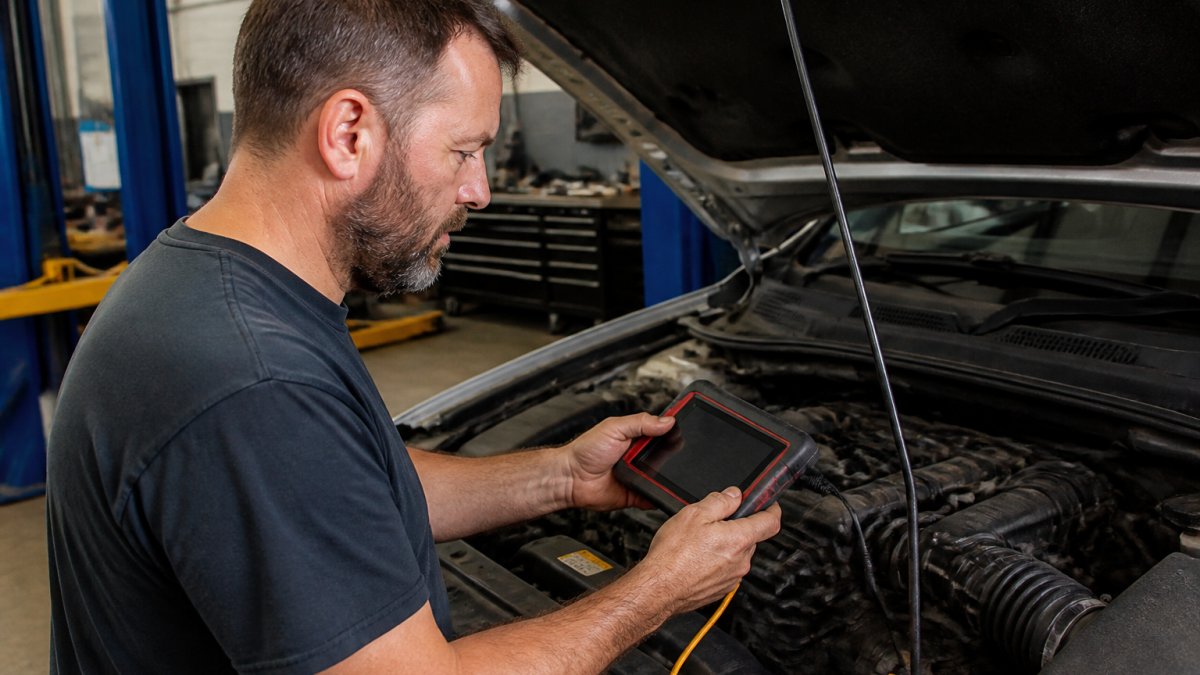
Vehicle diagnostic tools read diagnostic trouble codes from your engine control unit and display live sensor readings to identify what’s wrong with your vehicle. Modern tools go beyond basic code reading to show actual sensor voltage, compare it to expected values, and control certain vehicle functions for testing.
- Every vehicle sold since 1996 has an OBD-II diagnostic port under the dashboard that lets any compatible scanner communicate with the engine control unit.
- A code reader is one-way and listens only, while a bidirectional diagnostic tool can send commands to test circuits by commanding actuators like fuel injectors or cooling fans to act.
- Professional diagnostic tools scan all vehicle modules including engine, transmission, ABS, and airbag systems, while basic code readers access the engine module only.
- Freeze-frame data captures a snapshot of sensor readings at the moment a fault was detected, helping technicians reproduce the conditions that triggered the code.
Table of Contents
- What Modern Vehicle Diagnostic Tools Are and How They Work
- Understanding OBD-II Scanners and the Diagnostic Port
- How to Use an OBD2 Scanner to Read Vehicle Data
- Vehicle Fault Codes Explained: From Check-Engine Light to Root Cause
- Professional Vehicle Diagnostic Equipment and Advanced System Scanning
- Diagnostic Scan vs Mechanical Inspection: When Each Matters
- Getting a Professional Diagnostic at Northside Autocare
- Frequently Asked Questions
What Modern Vehicle Diagnostic Tools Are and How They Work
Modern vehicle diagnostic tools have evolved far beyond simple code readers, interpreting data from sensors and electronic control modules to identify what’s actually wrong.
The core function remains the same, read diagnostic trouble codes from your engine control unit, but capability has expanded dramatically.
According to research on vehicle diagnostics technology, vehicles now rely on sensors, control modules, and software to monitor performance continuously.
Understanding OBD-II Scanners and the Diagnostic Port
Every vehicle sold since 1996 has an on-board diagnostics port, commonly called the OBD-II port. This standardised connector sits under the dashboard on the driver’s side, typically within arm’s reach of the steering wheel.
An OBD-II scanner is a handheld device or software application that connects to this port and retrieves stored diagnostic trouble codes, pending codes, and live data.
The diagnostic port itself is passive: it only receives data your vehicle is willing to share, so connecting a scanner cannot damage your vehicle or cause false faults.
Protocols, pins, and what the port actually carries
The OBD-II connector is a 16-pin trapezoid. Pin 16 is battery positive, pins 4 and 5 are grounds, and the remaining pins carry the communication buses. Most modern vehicles use CAN (Controller Area Network) on pins 6 and 14, but older vehicles may use ISO 9141, KWP2000, or J1850 PWM/VPW. A scanner that does not support the vehicle’s protocol may power on but fail to communicate, protocol coverage matters as much as code coverage.
Before buying or borrowing a scanner, check the protocol list in its specifications. CAN coverage is standard on most tools sold today, but if you work on pre-2008 vehicles, confirm support for the older protocols as well.
Compatibility, modules, and software updates
OBD-II standardisation guarantees access to emissions-related engine data, but not to every module. Transmission, ABS, airbag, body control, and infotainment modules often sit on manufacturer-specific protocols or require enhanced software, the practical difference between a generic OBD-II reader and a make-specific diagnostic tool.
A practical compatibility checklist:
- Model-year coverage: confirm the tool lists your vehicle’s year range, not just the make.
- Supported modules: check whether the tool claims engine-only access or full-system access (engine, transmission, ABS, airbag, body).
- Protocol support: verify CAN and any older protocols your fleet uses.
- Software and subscriptions: many professional tools require annual subscriptions for new model-year coverage and service functions. Confirm the renewal cost in AUD before committing.
- Updates: check how updates are delivered (USB, Wi-Fi, or PC software) and how often they are released.
A tool that reads codes on a 2015 vehicle may not communicate with a 2024 model if its software database has not been updated. Model-year coverage is a software question, not a hardware one.
Wireless, Bluetooth, and smartphone-based adapters
Bluetooth and Wi-Fi OBD-II adapters paired with a smartphone app are a popular low-cost entry point, typically providing code reading, live data, and basic freeze-frame data. Their limits matter: most consumer apps do not perform bidirectional controls, module scans, or service functions such as DPF regeneration or ABS bleeding, and some upload vehicle data to cloud services. For DIY fault-code reading they are useful; for complex faults they are a starting point, not a substitute for a professional tool.
How to Use an OBD2 Scanner to Read Vehicle Data
Using an OBD-II scanner involves a straightforward sequence. Locate your vehicle’s OBD-II diagnostic port, usually under the steering column or to the left of the pedals, and connect your scanner’s cable.
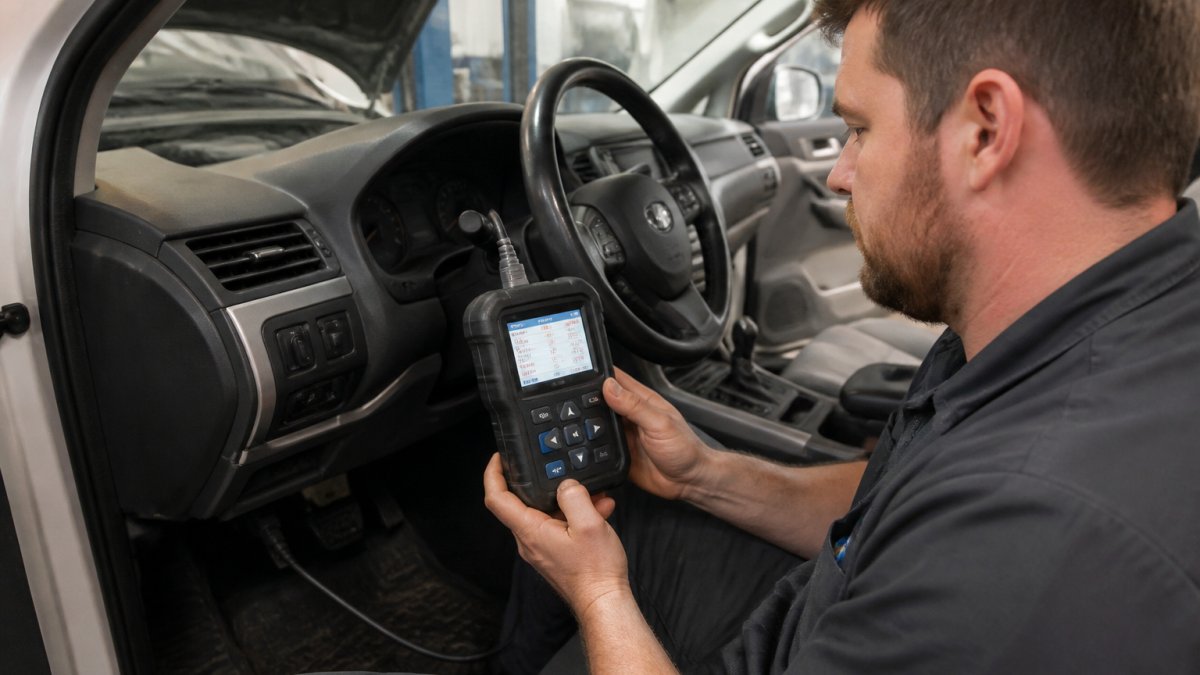
Turn the ignition to the “On” position without starting the engine; most scanners begin communicating automatically.
Each code is a letter followed by four numbers. The letter indicates the reporting system: P for powertrain, B for body, C for chassis, U for network. The numbers narrow the fault: P0300 means a random engine misfire, P0420 a catalyst efficiency problem. Codes are standardised, so P0300 means the same thing whether you’re scanning a 2015 Holden or a 2024 Nissan.
Once you’ve read the codes, select “Live Data” for real-time readings such as engine temperature, oxygen sensor voltage, fuel pressure, and air intake flow.
Vehicle Fault Codes Explained: From Check-Engine Light to Root Cause
The check-engine light illuminates when your vehicle’s engine control unit detects a fault affecting emissions, engine performance, or safety systems.
Diagnostic trouble codes communicate what the vehicle found, but a code doesn’t always point directly to the faulty component, it indicates which system detected a problem, not which part caused it.
Reading a code is not the same as diagnosing a fault.
Watch out: misinterpreting a code and replacing the wrong component is expensive and leaves the original fault unresolved, a common outcome when owners rely on code readers alone.
Professional Vehicle Diagnostic Equipment and Advanced System Scanning
Professional diagnostic equipment goes well beyond reading codes. Advanced scan tools access multiple vehicle systems simultaneously, engine, transmission, ABS, airbag, body electronics, and network communications, and perform bidirectional control, commanding actuators to act for testing. That capability is essential for modern vehicle diagnostics.
An actuator test might command fuel injectors to pulse, the cooling fan to activate, or the ABS system to cycle its self-test.
Bidirectional controls, live data, and module scans
Bidirectional controls are the clearest dividing line between a code reader and a diagnostic tool. A code reader is one-way: it listens.
Live data adds context: a mass airflow sensor value at idle tells you little alone, but comparing it to expected values at idle, under load, and during a snap-throttle test shows whether the sensor is reporting plausibly.
Module scanning matters because modern vehicles distribute control across many modules: an ABS fault may store codes in the ABS, engine, and body control modules, so a tool that scans only the engine module misses the full picture.
Service functions and why they exist
Professional tools also handle service functions beyond fault diagnosis: oil resets after an oil change, forced DPF regeneration, automated ABS bleeding, steering angle sensor calibration so stability control knows the wheel’s exact position, and TPMS resets after new tyres are fitted.
These functions exist because modern vehicles require precise calibration and software updates that cannot be performed manually, the vehicle’s computer must be told a service has been performed. Professional diagnostic equipment handles them as core capability.
Advanced tools are not just faster code readers. They test circuits, scan every module, and perform calibration and reset procedures that a basic reader cannot. That capability is what separates a diagnosis from a guess.
The limits of codes and the risk of misdiagnosis
A diagnostic trouble code identifies a condition the vehicle has detected, not necessarily the failed part. A P0171 lean code can stem from a vacuum leak, faulty oxygen sensor, weak fuel pump, clogged injector, or failing mass airflow sensor; replacing the oxygen sensor because the code mentions its circuit is a common, expensive mistake.
A safe process looks like this:
- Read all codes across all modules, not just the engine module.
- Review freeze-frame data to understand the conditions when the fault was stored.
- Compare live data to manufacturer specifications under the same conditions.
- Use bidirectional controls to test the suspect circuit or actuator.
- Confirm with physical checks, such as a smoke test for vacuum leaks or a fuel pressure test.
- Repair, clear codes, and verify with a road test that the fault does not return.
Clearing codes before diagnosing erases the freeze-frame data and pending codes that would have helped confirm the root cause. Read first, then diagnose, then clear.
Electric and hybrid vehicle considerations
Electric and hybrid vehicles add high-voltage systems requiring specific safety procedures and compatible tools. High-voltage battery, inverter, and motor control systems are accessed through manufacturer-specific diagnostic functions, and circuits must be de-energised and verified before work begins. Confirm tool compatibility before diagnosis, here the tool and the technician’s training matter equally.
Professional diagnostic tools offer capabilities that distinguish them from basic code readers.
| Capability | Purpose | Code Reader | Professional Tool |
|---|---|---|---|
| Read codes | Retrieve stored fault codes | Yes | Yes |
| Live data | Display real-time sensor readings | No | Yes |
| Freeze-frame data | Capture sensor snapshot at fault moment | No | Yes |
| Module scanning | Access engine, transmission, ABS, airbag systems | Engine only | All supported modules |
| Bidirectional control | Command actuators to test circuits | No | Yes |
| Service functions | Oil resets, DPF regeneration, ABS bleeding | No | Yes |
Diagnostic Scan vs Mechanical Inspection: When Each Matters
A diagnostic scan and a physical mechanical inspection serve different purposes, and both are often necessary.
Take a transmission problem: a scan might show a fault code for transmission pressure or shift timing, telling you the control module detected an issue.
Many faults require both. An oxygen-sensor check-engine light might come from a faulty sensor, but a physical inspection might reveal a vacuum leak letting unmetered air into the engine.
Getting a Professional Diagnostic at Northside Autocare
Our approach combines modern diagnostic scanning with thorough mechanical inspection: we read your vehicle’s diagnostic data, interpret what it’s telling us, and verify conclusions physically.
Vehicle Diagnostics services and how we approach diagnosis provide detailed insight into our diagnostic process.
Modern vehicle diagnostic tools have transformed how mechanics identify and resolve faults, moving beyond simple code reading toward live data interpretation, service functions, and precise system scanning.
Frequently Asked Questions
How do modern vehicle diagnostic tools work?
Modern vehicle diagnostic tools communicate with your vehicle’s engine control unit (ECU) and other control modules through the OBD-II port. They read live sensor data, freeze-frame information, and diagnostic trouble codes that the vehicle’s systems generate when a fault occurs. Advanced tools go beyond basic code reading to display real-time engine parameters, perform service functions like oil resets and DPF regeneration, and even test actuators. This allows technicians to identify issues accurately rather than relying solely on fault codes, which can sometimes point to symptoms rather than root causes.
What is the difference between a basic OBD scanner and professional vehicle diagnostic equipment?
Basic OBD-II scanners read and clear diagnostic trouble codes, making them useful for identifying that a problem exists. Professional vehicle diagnostic equipment does much more: it displays live data from multiple sensors, shows freeze-frame data captured at the moment a fault occurred, performs bidirectional control (testing actuators like fuel injectors), and accesses service functions specific to your vehicle. Professional tools also support more vehicle systems (ABS, airbag, transmission, emissions) and handle different diagnostic protocols. For accurate troubleshooting and repair verification, professional equipment is essential because it reveals what sensors are actually reporting, not just that something failed.
Can a car diagnostic tool tell you exactly what is wrong?
A diagnostic tool identifies fault codes and live data, but interpreting that data correctly requires expertise. A fault code might indicate a sensor failure, a wiring problem, or a mechanical issue, the code alone does not always reveal the root cause. For example, a misfire code could mean a faulty spark plug, a fuel injector problem, or a compression issue. This is why professional diagnosis combines scan results with mechanical inspection and testing. A skilled technician uses the diagnostic data as a starting point, then confirms the actual problem through further investigation. Misdiagnosis happens when someone acts on a code without verifying the underlying cause.
When should you take your car to a mechanic instead of using a scan tool?
Use a scan tool to identify that a problem exists and gather diagnostic data. Take your vehicle to a professional mechanic when you need accurate diagnosis, repair verification, or work on systems beyond basic code reading. Mechanics have professional diagnostic equipment, training to interpret scan results correctly, and the ability to perform physical inspections and tests that no scan tool can do alone. If your check-engine light is on, a scan tool tells you there is a fault; a mechanic determines what caused it and fixes it safely. Professional diagnosis prevents costly mistakes and ensures repairs actually solve the problem.


