
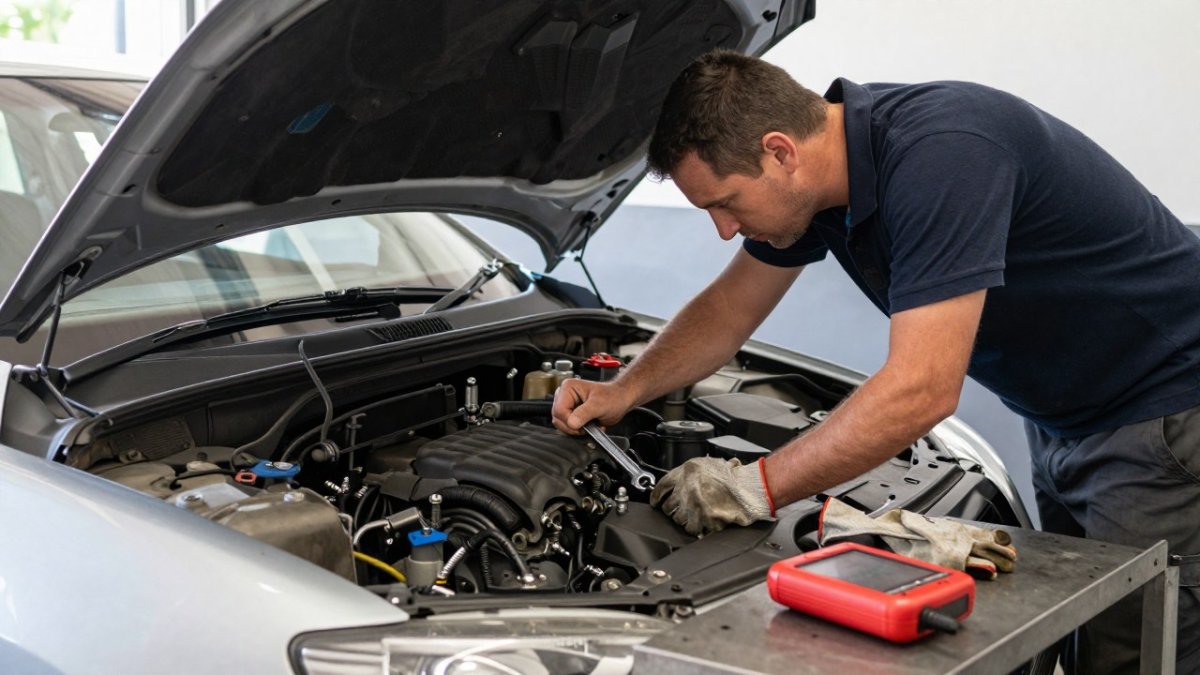
Quick Summary
Car mechanical repair costs in Australia depend mainly on the vehicle, the fault, the parts needed and the workshop’s hourly labour rate. Common repairs like front brake pads range from $180 to $350, while a clutch replacement can cost $900 to $2,200. Always ask for an itemised quote before approving work.
- Labour is usually the largest cost, and workshops charge by the hour.
- Front brake pads, fitted, typically cost $180 to $350 (AUD, including GST).
- Clutch replacement, fitted, typically costs $900 to $2,200 (AUD, including GST).
- A diagnostic scan typically costs $90 to $220 and should be shown separately on the quote.
- A fair quote itemises parts, labour hours, hourly rate, diagnostic fee and total including GST.
Table of Contents
- How Much Car Mechanical Repairs Cost and Why Prices Vary
- Typical Car Servicing and Repair Costs by Vehicle Type
- Common Car Repairs and Their Price Ranges
- What a Fair Mechanic Quote Should Include
- How to Compare Mechanic Quotes Side by Side
- Repair or Replace Your Car: Deciding With the Numbers
- Booking Your Next Inspection or Repair With Northside Autocare
- Frequently Asked Questions
How Much Car Mechanical Repairs Cost and Why Prices Vary
Car mechanical repair prices in Australia depend on the vehicle, the fault, the parts needed and the hourly labour rate of the workshop. Two cars with the same symptom can produce very different quotes. Understanding what drives those numbers is the fastest way to avoid overpaying.
Labour is usually the largest variable. Workshops charge by the hour, and the time a job takes depends on how easy the component is to reach. A water pump on a small hatchback may take far less time than the same part on a tightly packaged engine bay.
Parts are the second driver. Ask your mechanic which option they have quoted and why.
Diagnostic time is often overlooked. Finding the cause of a fault can take a technician an hour or more before any repair begins, and a fair quote should show that charge separately.
Location and vehicle age also play a role. Urban workshops generally carry higher overheads than regional ones, and older or less common models may need harder-to-source parts.
Typical Car Servicing and Repair Costs by Vehicle Type
Vehicle type changes the cost of nearly every job. A small car with a simple engine layout is usually cheaper to service than a large SUV or a four-wheel drive with additional drivetrain components.
Four-wheel drives add time and parts. Transfer cases, differentials and driveline components all need attention during servicing, and they often add to labour hours.
Small cars and medium vehicles tend to sit at the lower end of the price range. Their components are usually more accessible and more widely available.
Ask any workshop to explain how vehicle size and drivetrain affect its quote. A clear answer is a good sign.
Minor Service Versus Major Service Costs
A minor service typically covers oil and filter replacement, a visual inspection and fluid top-ups. A major service adds items such as air filters, spark plugs or coolant changes, depending on the manufacturer’s schedule. Your logbook service schedule will tell you which items apply at each interval.
The gap between the two can be substantial. A major service costs more because of extra parts and labour, so check your logbook before accepting a quote that looks unusually high or low. Logbook servicing is carried out to the manufacturer’s requirements, which helps keep your warranty compliant.
Labour Rates, Parts and Diagnostic Fees
Labour rates vary by workshop type, and the hourly figure should be stated on every quote. Parts are usually listed separately, and diagnostic fees may apply before any repair is confirmed.
Ask for each of these three items to be itemised. That way you can see exactly what you are paying for and compare quotes on the same basis.
Common Car Repairs and Their Price Ranges
Some repairs come up far more often than others. Brakes, clutches, cooling-system components and diagnostics are among the most common requests workshops handle.
| Repair | Typical price range (AUD, including GST) | What drives the price |
|---|---|---|
| Brake pads, front pair (fitted) | $180-$350 | Pad quality, whether rotors are machined or replaced |
| Brake pads and rotors, front pair (fitted) | $350-$700 | Rotor size, genuine versus aftermarket parts |
| Clutch replacement (fitted) | $900-$2,200 | Gearbox removal time, single-mass versus dual-mass flywheel |
| Timing belt and water pump (fitted) | $700-$1,500 | Engine access, whether seals and tensioners are included |
| Radiator replacement (fitted) | $450-$900 | Cooling-system layout, transmission cooler integration |
| Alternator replacement (fitted) | $500-$1,100 | Output rating, reconditioned versus new |
| Starter motor replacement (fitted) | $450-$950 | Engine bay access, genuine versus aftermarket |
| Diagnostic scan and fault tracing | $90-$220 | Whether a road test and live-data logging are included |
| Logbook minor service | $180-$320 | Oil grade, filter quality, number of inspection points |
| Logbook major service | $450-$900 | Spark plugs, air and cabin filters, coolant, brake fluid |
Typical price range (AUD, including GST)
These ranges assume a common passenger vehicle in reasonable condition and a workshop charging a mainstream labour rate. They are a starting point, not a fixed quote. A four-wheel drive, a European model or a vehicle with seized fasteners will often sit above the top of the range, while a small hatchback with easy access may sit below it.
The cost depends on the vehicle, the parts chosen and whether rotors also need replacing. If a workshop quotes only pads without measuring rotor thickness, ask for the measurement, fitting new pads to worn rotors is a false economy.
Clutch replacement is more labour intensive. Because the gearbox often has to come out, labour makes up a large share of the bill. You can compare what is included in our clutch and brake repair service. On vehicles with a dual-mass flywheel, the flywheel itself may need replacing at the same time, which can add several hundred dollars.
Paying for an accurate diagnosis first often prevents unnecessary parts replacement. A useful rule: if a mechanic suggests a major component replacement without a clear diagnosis, ask why. You can learn how our vehicle diagnostics process traces the fault before any parts are quoted.
Parts quality changes the number as much as the job does. Genuine parts carry the manufacturer’s warranty and fit first time, aftermarket parts can be cheaper but vary widely in quality, and reconditioned parts sit in between. Ask which category each line on your quote falls into, because a $200 gap between two quotes is often a parts-quality gap rather than a labour gap.
A workshop that can explain why your job sits above or below these ranges is giving you a more useful answer than one that simply quotes a number.
What a Fair Mechanic Quote Should Include
A fair quote is clear, itemised and easy to question. It should list each part with its price, the labour hours and the hourly rate, any diagnostic fee, and the total including GST.
Check for these items before you approve the work:
- Vehicle make, model, year and registration
- Description of the fault or work requested
- Each part listed separately, with genuine or aftermarket noted
- Labour hours and the hourly rate
- Diagnostic fee, if applicable
- Total price including GST
- Estimated completion time and warranty on parts and labour
If a quote lacks any of these, ask for it to be revised before you agree.
How to Compare Mechanic Quotes Side by Side
Comparing quotes only works when the jobs are the same. Make sure each quote covers the same fault, the same parts quality and the same level of service. The checklist below turns that principle into something you can actually do at the kitchen table.

Step 1, Confirm the scope is identical. Check that every quote names the same fault, the same components and the same inspection or road test. A quote for ‘brakes’ may mean pads only, pads and rotors, or a full hydraulic overhaul. If the scopes differ, the totals are not comparable.
Step 2, Line up the labour hours. A big gap in hours can mean one workshop has diagnosed the problem differently, or that one has allowed for seized bolts and the other has not. Ask each workshop how many hours it has allowed and why. A large difference in labour hours is worth questioning before you decide.
Step 3, Compare the parts line by line. A cheaper quote may use aftermarket parts where another uses genuine ones, so confirm the difference before judging value. Ask for the brand, the part number and the warranty period on each line.
Step 4, Check the diagnostic and consumable charges. Diagnostic fees, shop supplies, environmental levies and disposal charges can add to a bill. Ask whether these are included in the total or added later.
Step 5, Confirm GST and the total. Every quote should state whether the total includes GST. A quote that shows a pre-GST figure and a post-GST figure is clearer than one that shows a single number without a label.
Step 6, Read the warranty terms. Parts and labour warranties are often different lengths. Ask what happens if the same fault returns in three months, and whether the warranty is honoured at another branch or only at the original workshop.
Step 7, Check the approval process. A fair quote states that no additional work will be carried out without your approval, and how that approval will be sought, phone, SMS or email. If a workshop cannot explain this, ask before you leave the car.
Step 8, Distinguish an estimate from a fixed quote. An estimate is an informed guess that can change once the vehicle is inspected; a fixed quote is a commitment to a price for a defined scope. Ask which one you are holding. If it is an estimate, ask what could change it and by how much.
Finally, look at what is included. A quote with a warranty and a clear completion time may be worth more than a slightly cheaper one without either. Compare the total, the warranty and the timeframe together, not the headline number alone.
Repair or Replace Your Car: Deciding With the Numbers
Sometimes the repair bill is close to the value of the car. A useful test is to compare the expected repair cost with the vehicle’s current market value and the cost of ongoing maintenance over the next year.
If the repair is small relative to the car’s value and the rest of the vehicle is sound, repairing usually makes sense. If the repair is large and other components are also wearing out, replacing may cost less over time.
Ask your mechanic which repairs are urgent for safety and which can wait. Brakes, steering and tyres are usually priority items. Less critical faults can often be scheduled later.
Booking Your Next Inspection or Repair With Northside Autocare
Northside Autocare offers manufacturer-approved logbook servicing, specialised 4WD servicing and upgrades, and safety and RWC/COI certification. Each service is designed to keep your car safe, reliable and within manufacturer requirements.
For current prices or a quote, contact Northside Autocare directly. To book your next inspection or repair, contact Northside Autocare or read what a logbook service includes before you visit.
Last Updated: November 14, 2026
Book your next service with Northside Autocare for clear pricing and manufacturer-compliant work.
Frequently Asked Questions
How much do common car mechanical repairs cost?
Costs depend on the vehicle, the part and how long the job takes. Routine servicing is usually the lowest-cost item, while transmission, engine and suspension work can run much higher. Labour is charged by the hour, and parts are added on top. For current pricing on your specific vehicle, contact Northside Autocare directly for a quote.
What factors affect the price of a car repair?
The main factors are the make and model, the age and condition of the vehicle, the type of part (genuine, OEM or aftermarket), the workshop’s hourly labour rate and how much diagnostic time the fault needs. Access to the component also matters, as hidden parts take longer to reach. Asking for these figures separately on a quote makes it easier to understand where the cost comes from.
How can I tell if a mechanic’s quote is fair?
A fair quote itemises parts and labour, states the hourly rate, explains what the fault is and why the work is needed, and makes clear which items are urgent and which can wait. Be wary of vague totals or pressure to approve everything at once. Comparing with a second quote for the same job, and asking the mechanic to walk you through the findings, will usually show whether the price is reasonable.
Should I get more than one quote for car repairs?
For larger jobs, yes. A second quote helps confirm the diagnosis and the scope of work, and it shows whether one workshop’s labour time or parts pricing is out of line. For small, urgent repairs such as a flat battery, getting a quote from a trusted workshop you already use is usually enough. Always ask both workshops to quote on the same specification so the figures are comparable.


